

AI Act aims to promote trustworthy and human-centric artificial intelligence, while ensuring a high level of protection for health, safety, and fundamental rights – including democracy, the rule of law, and environmental protection.
The AI Act establishes a regulatory framework based on the level of risk associated with artificial intelligence systems, targeting four risk levels: unacceptable, high, limited, and minimal or no risk.
Specific requirements are set out for each risk category, covering either transparency alone or additional obligations imposed on operators, depending on the level of risk the AI systems may pose. Given the risks they entail, certain AI systems are prohibited under the Regulation.
Unacceptable risk
Certain AI systems can have harmful effects and be particularly abusive as they contravene human dignity, freedom, equality, democracy, the rule of law, or the fundamental rights and freedoms enshrined in the Charter of Fundamental Rights of the European Union; for this reason, they are prohibited.
Pursuant to Article 5 of the AI Act, as amended by the Digital Omnibus on AI, the following are prohibited as of 2 February 2025:
- AI systems that deploys subliminal or manipulative techniques to materially distort the behaviour of a person or a group of persons (harmful manipulation or deception);
- AI systems that exploit any of the vulnerabilities of a natural person or a specific group of persons due to their age, disability, or a specific socioeconomic situation to significantly distort behavior;
- AI systems that evaluate or classify persons based on social behavior (social scoring);
- AI systems that assess or predict risks related to individual criminal offenses;
- AI systems that create or expand facial recognition databases without a specific purpose;
- AI systems that infer emotions in schools or the workplace (with safety- or medical-related exceptions);
- biometric classification AI systems used to infer certain sensitive data;
- real-time remote biometric identification AI systems for law enforcement purposes in publicly accessible spaces, subject to certain exceptions.
The following two types of AI systems are prohibited under the Digital Omnibus on AI, for which the prohibitions apply starting 2 December 2026:
- AI system that generates or manipulates realistic images, videos, audio or similar material of an identifiable natural person’s intimate parts, or of an identifiable natural person engaged in sexually explicit activities, without that person’s consent;
- AI systems that generates or manipulates material constituting child sexual abuse material or child pornography performances.
The European Commission has published two documents relevant to prohibited AI systems, aimed at both providers and authorities:
High risk
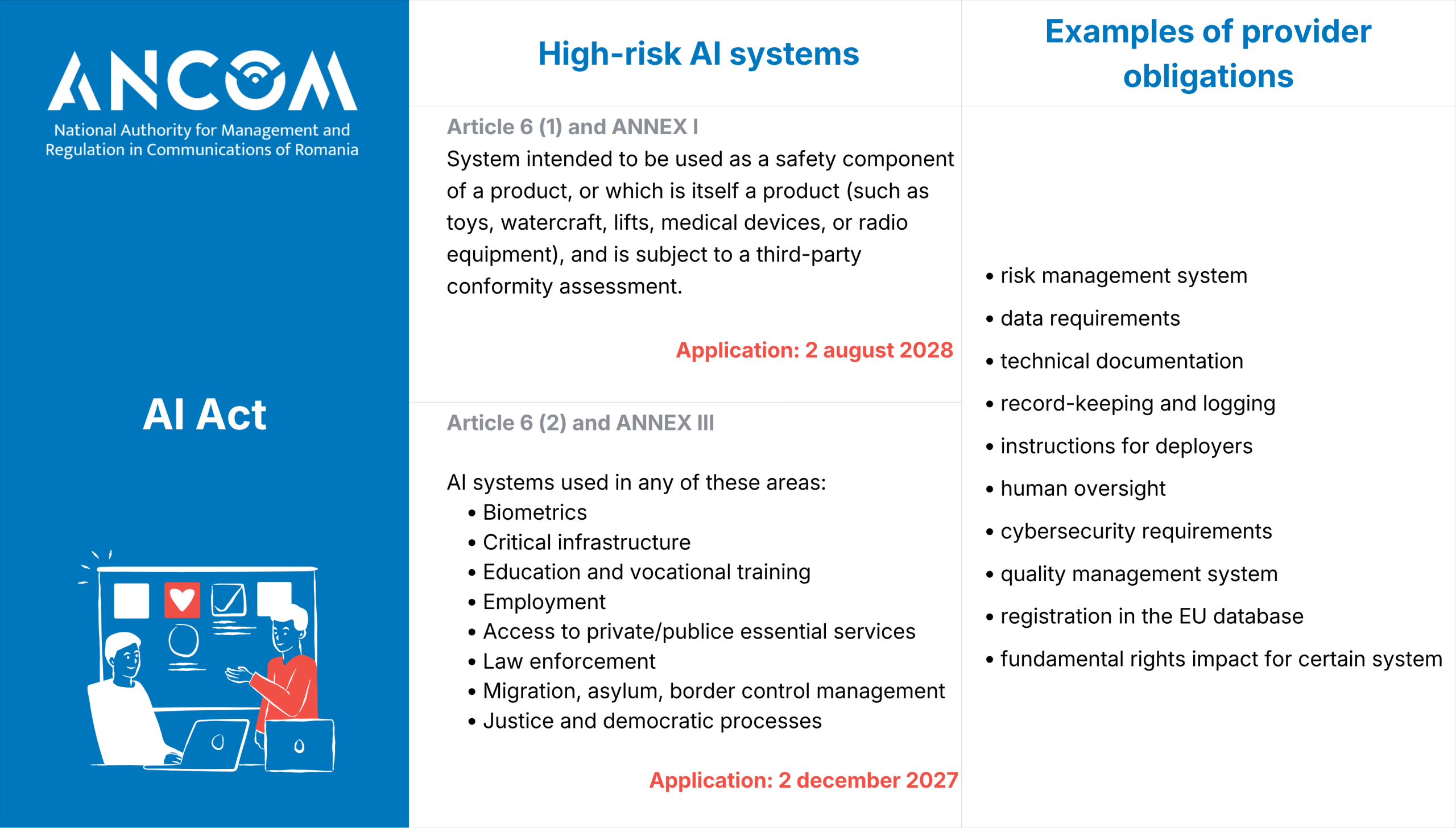
Providers of high-risk AI systems - as referred to in Article 6(1) and (2) and Annexes I and III to the AI Act - must ensure that those systems comply with a set of mandatory requirements.

These mandatory requirements ensure that high-risk AI systems available in the Union, or whose outputs are used in the Union, do not pose unacceptable risks to users, particularly regarding health, safety, or fundamental rights.
Limited risk
The risk posed by certain AI systems can be minimized through transparency, in accordance with Article 50 of the AI Act. Providers and deployers of such AI systems (including general-purpose AI systems - more details on these systems here) are subject to transparency obligations, such as informing natural persons that they are interacting with an AI system when such systems are designed to interact directly with natural persons, or disclosing that specific content has been artificially generated. Further details regarding transparency obligations can be found on the dedicated page, here.
Minimal or no risk
All other AI systems are classified as minimal- or no-risk systems. They are not subject to any obligations under the AI Act.