

As of 2 August 2026, the provisions of Article 50 of the AI Act concerning transparency obligations applicable to certain artificial intelligence systems become applicable.
An extended period before the rules take effect is granted to providers of AI systems – including general-purpose AI systems that generate synthetic audio, image, video, or text content – that placed such systems on the market before 2 August 2026. For these providers, the obligation to label generated content applies starting from 2 December 2026.
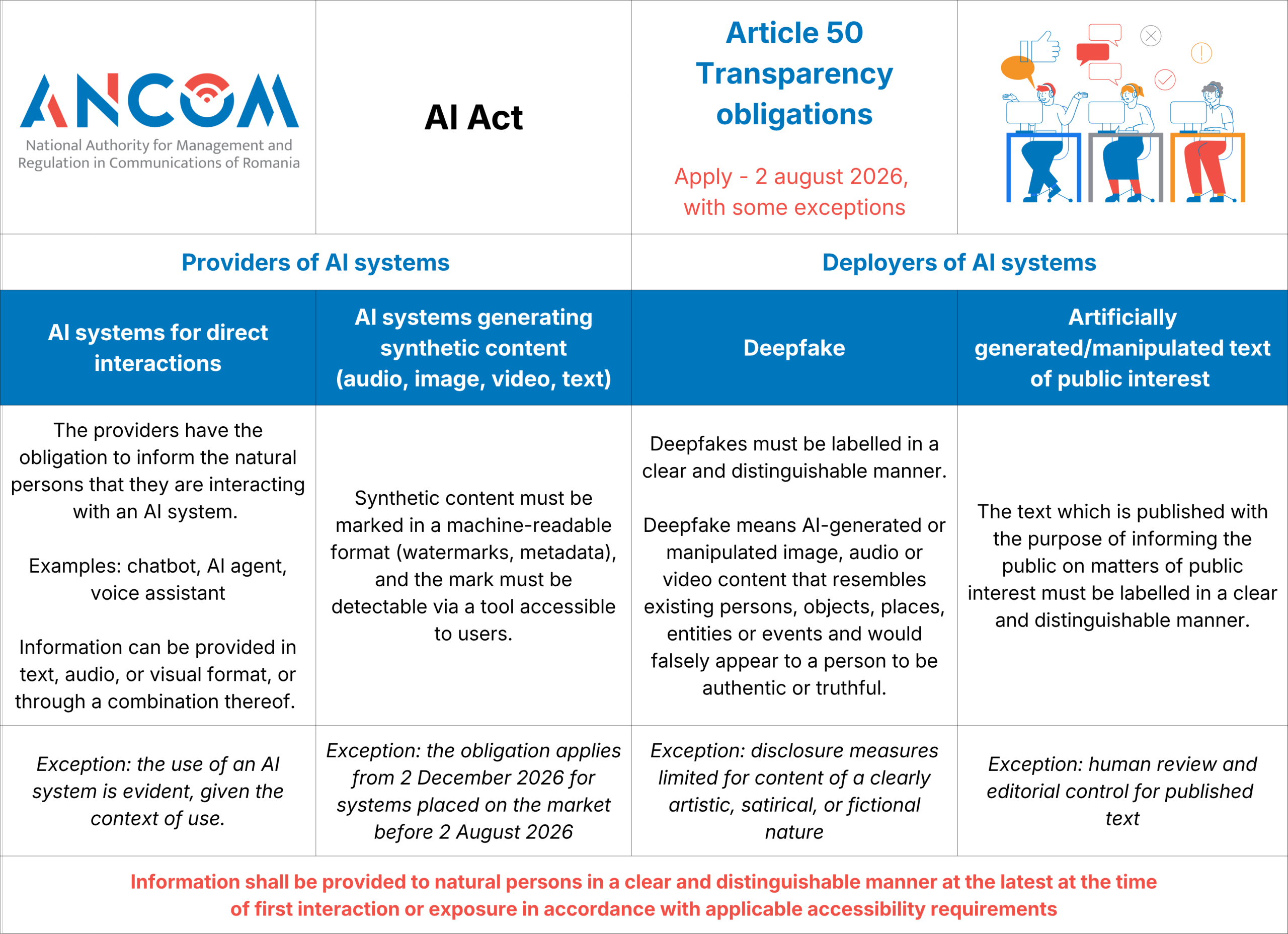
Article 50 of the AI Act establishes transparency obligations for providers and deployers of certain artificial intelligence systems, as follows:
- providers of artificial intelligence systems – including general-purpose AI systems – that generate synthetic content in audio, image, video, or text format are required to mark such content as artificially generated or manipulated, and
- deployers of an AI system that generates or manipulates images, audio, or video content constituting deepfakes are required to disclose (label) the fact that such content has been artificially generated or manipulated.
Furthermore, the deployers of AI systems that generate or manipulate a published text intended to inform the public about matters of public interest are required to disclose (label) the fact that the content was artificially generated or manipulated, unless the AI-generated content has undergone a process of editorial or human review.
The previously mentioned labelling obligations do not apply where the artificial intelligence system is used for a personal, non-professional activity.
Also effective from August 2, 2026, is the obligation for providers of artificial intelligence systems intended to interact directly with natural persons to design and develop such systems so that the persons concerned are informed that they are interacting with an artificial intelligence system, unless this is obvious from the circumstances and the context of use.
The provider is a natural or legal person, public authority, agency or other body that develops an AI system or a general-purpose AI model or that has an AI system or a general-purpose AI model developed and places it on the market or puts the AI system into service under its own name or trademark, whether for payment or free of charge.
The deployer is a natural or legal person, public authority, agency or other body using an AI system under its authority except where the AI system is used in the course of a personal non-professional activity,
These obligations aim to enable users to more easily identify when they are interacting with an artificial intelligence system or when specific content has been generated or modified with its help.
Infographic on the transparency obligations
The European Commission guidelines on transparency obligations
The guidelines clarify the scope and application of transparency obligations, including regarding interaction with artificial intelligence systems, as well as the marking and labelling of content generated or manipulated with the help of AI.
Code of Practice on Transparency of AI-generated Content
The European Commission publishes the Code of Practice on Transparency of AI-generated Content, voluntary document offering practical recommendations to interested entities.